Hawes Mechanical Television Archive by James T. Hawes, AA9DT
FET Preamplifier FAQs

JFET Preamp Pages

Frequently Asked Questions

Don Tillman brought up several excellent questions about the JFET amplifier. I have a little different take on these questions. For you half -dozen supporters of www.hawestv.com, here are my five cents. I've also added one or two questions of my own. Click a topic below. Or scroll down to my answer...


QUESTION. Can I buy a preamp from you? Will you build me one?

ANSWER. What are you offering me? Bids start at $100, cash in advance. But hey, this is really a do-it-yourself project. Before sending money, please read the next question.

If you'd still rather buy a preamplifier, why not buy a commercial one? The Para Acoustic includes a class-A, FET amplifier, plus an equalizer. You power the circuit with a 9-volt, internal battery or 48-volt, phantom power. The unit is stingy on the power requirement, too. This amp only uses 2.9 mA. The manufacturer claims that with an alkaline cell, you can get 200 hours of operation. The output impedance is 600 ohms, about a third of what my JFET amp develops. You can order from this site: Commercial JFET Preamp.


QUESTION. I don't know electronics. Can I build your preamp?

ANSWER. FETs can really challenge a first-time project builder. FETs are fragile. No two are alike. They're sensitive, temperamental and mischievous. Touch a FET the wrong way, and it goes away and never comes back. Can't cuss your way through a little old-fashioned trouble? Then don't bother with FET preamps. Those are the negatives. Here's the positive: A FET can produce the most melodious tones that you can imagine. Make a special effort. If you want to succeed badly enough, you will.


QUESTION. Where can I buy the MPF102 JFET?

ANSWER. Check out the sites below. Based on my personal experience, I highly recommend these vendors. I'm very proud to have Allied as an advertiser on this site. The parts are top quality and the service is second to none. Visit these sites and then please, come back...


QUESTION. Can I use a different FET?

ANSWER. The 2N3819 works well in this circuit. Note the different pinout, though! Digi-Key and Mouser carry the 2N3819. Below are some other JFET types that might work in my circuit. (I make no guarantees, and haven't tried these parts.)

  Pinout for a 2N3819 JFET
2N5458 BF244A BF245A
J113 J210

Using still other FETs might require circuit changes. “Replacement line” parts might or might not work. Also, such devices tend to be costly. To figure out your own substitution, check the device's datasheet. Can't understand it? Don't substitute.


QUESTION. What's your technique for FET substitution?

ANSWER. Here's a start. Look for a match or near-match in these three datasheet parameters...

  • IDSS • GFS • Typical VDD

Got your three-way match? You've probably found a sub! Buy a few of the matching parts and try them. Remember, no two FETs are exactly alike. For your tests, I suggest breadboarding the circuit on a component plug board. Radio Shack and other vendors sell the ideal model. Click... Plug board.

Get datasheets from...
Siliconix.

Fairchild


QUESTION. Can you get me a schematic for a different preamp?

ANSWER. Sure. Use the Google "search" feature at the bottom of this page.


QUESTION. Can I run the preamp off some other voltage?

ANSWER. Yes. I've redesigned the bias circuit for the voltages below. These are the voltages that I recommend. Voltages below 9 volts are too low for most FETs. At 6 volts, you'd probably lose all your gain. Operation at more than 18 volts is probably too inconvenient for battery power. Anyway, you're getting close to the maximum for the FET, 25 volts. (Do you want to play through it, or detonate it?) For an MPF102, the ideal voltage is 15 volts.

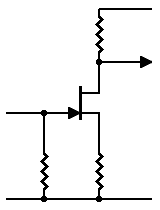
Note that the source and gate resistors (RS and RG) remain the same as before. Just substitute the drain resistor (RD) below for the one in the nine-volt circuit...

Vdd Rd
9V 1.5KΩ
12V 2.2KΩ
15V 2.7KΩ
18V 3.3KΩ
Schematic for JFET preamp at different power voltages


QUESTION. The preamp doesn't work. Can you help me to debug it?

ANSWER. For $50 an hour, cash in advance, minimum $100, maybe. Anyway, save your money. Here are the usual problems...

  • A reversed zener diode.

  • Reversed FET pins.

  • Static on the gate ate your JFET.

  • The wrong resistor value.

  • Wiring errors.

Also see our troubleshooting page.


QUESTION. What are some advantages of working with FETs?

ANSWER. There are several advantages...

  • Small size. With FETs, you could compress a tube preamp design down to a two-by-four inch circuit board. Not only would the resulting circuit be smaller. It would also be much lighter than the original. Yet the FET circuit would sound and perform just like the original.

  • Low power. You could power a FET amplifier with the 12-volt filament supply from a tube amplifier! (Be sure to rectify and filter the supply voltage.) If you power the circuit off batteries, expect the batteries to last a long time. For instance, a good MPF102 design only draws three milliamps per device.

  • Simple construction. You don't need a PC board or a device socket. If you're careful, you can just solder a JFET into your project. Buy parts with leads. They're quite compact, but large enough for assembly by human beings. You only need to connect three leads. The leads are nice and long. You can bend them and tack solder on resistors or capacitors. You can easily build FET circuits on unplated perfboard or even terminal strips.

  • Serviceable. With today's microscopic, surface-mount devices and large-scale integration, many circuit designers neglect serviceability. Leaded JFET designs are different. They're easy to service. Passive components, such as resistors and capacitors can be large enough to grasp with your fingers. You can easily replace leaded, discrete parts. You certainly don't need a pick-and-place machine! If an IC goes out of production, you might never get its circuit working again. JFET circuits are another story. Choose carefully, and you can replace one JFET type with another type. You might need to change a bias resistor. But you won't have to start over with a new circuit.

  • Single power supply. Unlike many op amps, FETs don't require split power supplies. One power supply is enough, and works just fine. Of course, if you want to build a complementary circuit with FETs, you can still use dual supplies.

  • Almost no heat output. FETs have no filaments to waste half of your power supply's output. The lack of filament heat means far less wear and tear on your amplifier. For example, heat dries out capacitors. Capacitors in a FET circuit should last much longer than capacitors in a tube circuit.

  • Sensitive. FETs are voltage-driven current sources. They're extremely sensitive. They draw no current from the input circuit. Here's a comparison of different devices. Typical transistor circuits have input impedances in the thousands of ohms. (Bootstrapping or Darlingtons can raise that impedance to a few million ohms.) Tube circuits have input impedances of up to a few million ohms. JFETs have input impedances of about a billion ohms. MOSFETs have input impedances of several billion ohms.

  • Low noise. FETs are far less noisy than either tubes or transistors are.

  • Graceful aging. Also, JFETs age far more gracefully than tubes do. Experts consider JFET aging as unnoticeable. Like tubes, MOSFETs age in a noticeable way.

  • NTC. With bipolar transistor circuits, you must protect against thermal runaway by adding external resistors. JFETs don't have this problem. What they have instead is a negative temperature coefficient. This coefficient protects the devices from thermal runaway.

  • Like designing with tubes. JFETs act like tiny tubes. If you know anything about tube design, you'll be right at home with JFETs and depletion MOSFETs. (Enhancement MOSFETs are different. Somewhat like transistors, enhancement devices require positive bias.)

  • Easier than tubes. JFETs are easier to connect than tubes are. You can solder JFETs right into your circuit. A JFET has no filament to burn out. With a triode tube, you connect five pins. With the equivalent JFET, you only connect three pins. A FET power supply can be more compact than most tube power supplies are.

QUESTION. I can't find the right values of metal film resistors at Radio Shack. Can I use carbon film or carbon composition resistors?

ANSWER. Yes, carbon film or carbon composition resistors are fine. Metal film resistors produce less noise than carbon composition resistors, though. Also, metal film resistors seem to have tighter tolerances than the usual carbon resistors. Your next choice after metal film is carbon film resistors. Carbon composition resistors should be your last choice.

Unless you're very particular about noise, don't let the resistor type bother you. If you're using a vintage amplifier, it probably has carbon composition resistors. Adding a few more shouldn't be a big problem. On the other hand, the input preamp is the most sensitive point in your amplifier. If you can buy the metal film resistors, definitely do it.

Unfortunately, Radio Shack has been reducing its parts stock. Every year or two, more resistor values go missing. We realize that resistors are low-margin items. Still, without the right resistor values, you can't program a transistor or JFET to work properly.

These vendors all sell metal film resistors...

Mouser Digi-Key Allied


QUESTION. Can I substitute for some resistor values that I can't find?

ANSWER. Some of the resistor values aren't critical. For example, you can use 1M instead of the 3.3M gate resistor. You can use 180K instead of the 220K pulldown resistor. At least at the start, don't substitute for the source and drain resistors (560 and 1.5K ohms). By the way, the 560-ohm bias resistor is only a typical value. Some JFETs require a different value. You must determine this value by testing. The best value gives you the most headroom and the least distortion. The specs for the MPF102 device are broad, and don't allow me to predict your results. The source resistor could be either smaller or larger than 560 ohms. I picked a value that works well with typical MPF102 devices. See my discussion at... Source Resistor.


QUESTION. I can't find a 3.3M resistor at Radio Shack. What should I do?

ANSWER. Use a 1M (one megohm) resistor instead. You'll lose a little sensitivity, but you'll gain lower-noise performance. Radio Shack sells a 500-pack of carbon-film resistors. Carbon film resistors are noisier than metal-film resistors, but carbon film parts will work. The Radio Shack resistor pack includes these circuit values...

  • 3.3M gate resistor

  • 1.5K drain resistor

  • 560-ohm source resistor

The 220K pulldown resistor isn't there. Still, you can substitute either a 180K resistor or a 270K resistor. Both are in the pack.


QUESTION. Why do some players prefer carbon resistors to metal film resistors? Aren't carbon resistors noisier than metal film resistors?

ANSWER. Metal film resistors produce less noise than either carbon composition or carbon film resistors. Yet what's "noise" to some is "ambience" or "presence" to others. The "noise" that a resistor produces is a natural sound. It could add a rough, sizzling, wild, rustic edge to a solo. If the others all use metal film resistors, maybe they all sound antiseptically pure. Maybe the guy with carbon resistors is the one with true grit. Or maybe he's really on fire. In the world of rock and blues music, being on fire can be as good as barbecue.

Just like the sound of water rushing over stones, or wind stirring through fir trees, "resistor sound" is real sound. Some scientists believe that the incomparable tone of a Stradivarius violin stems from shellac. The shellac gives the instrument's voice a natural ambience. If a musician can use the ambience of a shellac, then why not use the ambience of a carbon resistor? The choice is yours.


QUESTION. Will the JFET preamplifier work with a piezo pickup or a piezo element?

ANSWER. Yes, of course!

If you're building a guitar pickup, you might be using a piezo element. You can find such elements at Radio Shack, All Electronics and Electronics Goldmine. Make sure that you're getting an element and not a buzzer. You don't want the buzzer circuit. You just want the transducer.

Piezo elements are easy to work with, and you don't need to wind any coils. The soldering is the tricky part. You might need to buy a small amount of silver solder. Make sure that your iron is hot and clean. If the element has attached wires, use those wires. Splice a shielded cable to the element wires. Connect the cable to the guitar jack.


QUESTION. I'm building an amplified cigar-box guitar. The JFET preamp is a great start. But how can I boost the output enough to drive a speaker?

ANSWER. Today's semiconductors can do just what you need. For example, a Darlington or VMOS FET can drive a speaker directly. Just remember that the amplifier isn't a thing to itself. It needs power, usually a lot of it. In fact, the power supply could be the most difficult part of your project.

Fortunately for instant gratification, there's an easy way to get a speaker driver: Use a ready-made amplified speaker. These days, hamfests are brimming with surplus computer speakers. Add into the bargain that these speakers offer mid-to-high fidelity, and they're often stereo. You can add a pickup to your project and play in stereo! The speaker power supply usually comes with the speakers. When you buy, make sure that the speakers have volume controls. The controls are a tip-off that there's an amplifier inside.

You might not be lucky enough to get a power supply in the deal. In that case, saunter over to the next hamfest table. Don't worry. You'll find the supply. Just be sure to get one that's powerful enough. Typical computer speakers require 300 mA to about 2 amps. The input is DC voltage, and that varies, too. The most common voltages are 5, 6, 9 and 12 volts. The more powerful speakers take the higher voltages. A label on the bottom of the case usually provides ratings. This label usually only appears on one of the speakers, the heavier one. The heavier speaker contains the amplifier for both speakers.


QUESTION. I bought amplified speakers, but they didn't come with a power supply. How do I find the right power supply?

ANSWER. Here's what to look for in a supply...

  • The current type. Make sure that you're buying a DC supply. Some supplies put out AC. Look at the plug diagram on the power supply label. This diagram specifies whether the inside or outside of the plug is positive. If you don't see a diagram, you might have an AC supply. This is fine if your speakers need AC. Yet most require DC. Baffled? Measure the supply output with a meter (DVM).

  • Good wiring. The DVM test will also spot supplies with broken wires. The wires usually break near the plug or near the supply. If you suspect a break near the plug, you can replace the plug. Radio Shack and most hamfests will sell you a new plug. If you suspect a break near the supply, don't buy the supply. You can fix such a break, but you must disassemble the supply.

  • The exact DC voltage rating that your amplifier requires. The amp and power supply must match.

  • An output current rating that equals or exceeds what the amplifier requires. The closer, the better. Typical "wall wart" power supplies aren't regulated. The unloaded output voltage is higher than the rating. When you connect the supply, the amplifier draws down the voltage. If the supply puts out too much current, the amplifier might not draw the supply voltage down enough. Also, large supplies waste power. For these reasons, you can use a slightly larger supply. But avoid one that outputs three or four times the current that you need.

  • An output plug polarity that matches the amplifier polarity. If necessary, you can cut off the plug and change the polarity.

  • An output plug with the same length and diameter as the amplifier socket requires. Before buying the supply, try plugging the connector in. The plugs are color-coded. Notice the colored ring on the end of the power supply plug. If you know what color you need, matching is far easier. Some of the plugs are only slightly larger than others. If your only plug fits loosely, you'll need to change the plug.


QUESTION. Could I replace the preamplifier stages of my tube guitar amplifier with circuits like your JFET preamp?

ANSWER. Yes, you could! The circuit would work, too. Note that JFETs don't provide a "plug-in replacement." You must instead replace all the wiring for the entire tube stage. Whatever you do, please don't mangle a valuable antique!

Schematic: Input stages 
from classic Gibson GA-1RT guitar amplifier Input stages from Gibson GA-1RT guitar amplifier, a real classic

The easiest way to make the swap is this: Remove the tubes. Lay your perfboard circuit on top of the chassis. You can bolt it down later. Then disconnect the final coupling capacitor, isolating the old tube circuit. Now connect your JFET preamp and test it out.

The circuit that I've described is a one-JFET design without much gain. You can significantly boost the gain by adding a source resistor bypass capacitor. The result would be something like one stage of the original tube preamp in a guitar amplifier. Next, you'd eliminate the 220K resistor on the output and couple in another stage.

You'd also have to invent a new power supply for your JFET preamplifier. Whatever you do, don't hitch up the tube power supply. It will spread JFET fragments all over the room. And probably all across the state. Instead, you need a good, ripple-free, low-voltage supply. Maybe you can use the filament supply with a doubler circuit and filter. Or in a pinch, you can even use a battery.

Schematic: JFET redesign
of Gibson input stages. Operates on 12 volts. JFET redesign of Gibson input stages (Untested). Operates on 12 VDC power.

I'm not sure exactly how well the JFET version would work. JFETs can sound very fine, but I've never seen a tube-to-JFET sub book. What you propose to do is to replace one design with another. Nobody can say for sure if the new design is equivalent in every way. You'd have to try it, tweak it, and see how you like it. Fortunately, you could temporarily patch in a JFET amp. Just set the JFET breadboard atop the original tube chassis. You could capacitively couple the JFET preamp to the tube power amp. A few alligator clips would do the job...

  • One from the JFET drain capacitor to the power tube grid.

  • One from the JFET ground to the tube amp ground.

Then if you don't like the sound, you can make a decision...

  • Tweak it until it's perfect. For example, you might try different values for the 47μF feedback resistor.

  • Disconnect the new preamp and return to that golden oldie tube sound. That is, go back to the original design.

You'll save power with the FETs. They behave a lot like tubes. And JFETs do sound nice.

I mentioned battery operation. Some will want to operate the preamp on a nine-volt transistor battery. Nine-volt operation requires circuit changes. Here's a nine-volt version of my preamp...

Schematic: JFET 
redesign of Gibson input stages. Operates on 9 volts. JFET redesign of Gibson input stages (Untested). Operates on 9 VDC power.


Google Search
Web www.hawestv.com

WARNING. The author assumes no responsibility for your success or failure in using methods on these pages. Further, the author neither makes nor implies any warranty or guarantee as to the accuracy or effectiveness of these methods. Proceed at your own risk.

Copyright © 2007 by James T. Hawes. All rights reserved.

•URL: http://www.hawestv.com/mtv_FAQ/FAQ_fetpreamp1.htmWebmaster: James T. Hawes
•Revision—July, 2009 •Page design tools: HTML, Notepad & Explorer