JFET Preamp Pages
- Introduction
- Schematic & Parts
- How It Works
- Spec Spread
- Improve Performance
- MPF102 in Tillman Circuit
- Troubleshooting
- FAQ

|
|
A Guitar Preamp
with the MPF102 JFET
|
Now, with Easy to Find Parts! Some time ago, J. Donald Tillman designed an elegant JFET guitar preamplifier. He posted the circuit on the Web. Overnight, this circuit became very popular. And it's still a winner today. The reasons why are easy to see. This amp is easy to build. The circuit works like a champ. And the JFET's tube-like warmth sounds great. Plus, the high-impedance input won't load your guitar. And the medium output impedance combats high-frequency losses due to loading and long cables. And by the way, this FET preamp is great for microphones, too! |

|
Bad News...and Good. Unfortunately, Tillman's amplifier requires a J201 FET. The J201 is a very special device and an excellent choice. Yet it's uncommon to hobbyists. But my site solves the mystery. I've designed a similar preamplifier with an everyday JFET.
|
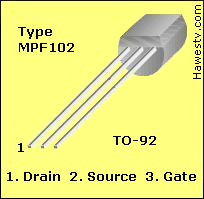
Many Advantages of MPF102. I've read the forums. Hobbyists want to use the famous MPF102 in Tillman's original design. The MPF102 is an excellent choice. It handles more current than the J201, making the MPF102 more rugged. The MPF102 can provide a stronger signal into a lower impedance load. And like many other JFETs, the MPF102 is a low-noise device. The MPF102 has a lower gain than the J201: An advantage, because it won't overload as fast as the J201 does. Still, Tillman optimized his design for the J201. The specs for an MPF102 are very different. Ignore the differences, and your amplifier might not work. For example... |
|
- The J201 requires only 0.2mA to 1 mA of drain current.
- The MPF102 operates on 2 to 20 mA. Run it on less, and you may get an attenuator instead of an amplifier! I can prove that statement. See... Proof
Summary of the DifferencesOn the table, notice that the MPF102 requires more current than does the J201. The current requirement is a major reason why you can't just plug an MPF102 into Tillman's circuit. This is a very poor substitution. It will disappoint you. (You might as well strum piccolo music on a bass guitar. You'll have more luck.) |
|
Achieve results that you can be proud of! When you build a circuit, you go to a lot of work. Make the effort pay off! My page offers a new preamp design, starting with the MPF102's specs. Now you have the right design for an MPF102 JFET preamplifier. Build carefully. You'll wind up with a satisfying project that you'll appreciate for years.
Oncoming Scarcity of MPF102 & J201
|
♦ CAUTION. Major manufacturers are exiting the JFET market. Others are ceasing production of leaded JFETs or MOSFETs. For instance, Siliconix has already left the JFET market. In 2011, Fairchild obsoleted the MPF102 and J201. Other JFETs that are compatible with the MPF102 (2N3819, 2N5458, etc.) are also obsolete! When current stocks run out, Fairchild will not provide more. For the time being, you can still buy these devices from vendors or factory representatives (see below.) In February 2013, Radio Shack discontinued the MPF102 (part 276-2062). Soon thereafter, stores ran out their stocks forever. Other vendors sell various substitutes, many by NTE. You'll have to order online. I recommend the NTE457. For more suggestions, click MPF102 Substitutes. |
Substitute PartsFairchild continues to manufacture the J113, a possible substitute for
the MPF102. Vendors such as Mouser and Digi-Key Other sources continue to make the MPF102 and J201...
|

|
- Central Semiconductor continues to manufacture the 2N3819. The 2N3819 is a reliable substitute for the MPF102. (The pinout differs.) Central also offers the J201, which you'll need for the Tillman circuit. Prices for these “end-of-life” devices tend to be high.
- Ebay Electronics Parts can find you deals on JFETs from China. Some of these deals are impressive. If you can arrange for air shipment, your order can arrive in a few days or weeks. I don't know if the parts come from Chinese foundries or elsewhere. Chinese MPF102s plug right into my circuit. I've bought 2N5457, J113, and 2SK370 JFETs from China. So far, the I've received excellent parts.
Catalog and Online Vendors...
|

|
Find a Vendor in Your Area...
| •Contact Central, Fairchild, or InterFET for a local representative! |
Go to Page: 1 2 3 4 5 6 7 8 FAQ Next
|
|
|
Copyright © 2007 by James T. Hawes. All rights reserved.
•URL: http://www.hawestv.com/amp_projects/fet_preamp/fetpreamp1.htm
|