Phase Selector
One color at a time. Col-R-Tel is a field-sequential color system. Its chroma demodulator can only process one color at a time. The purpose of the phase selector is to pick one of three color reference phases. Each reference phase allows the chroma demodulator to detect one color.
What it does. The color reference phases come from the phase shifter. At the phase selector input, all three phases arrive simultaneously. The selector discards two phases and sends the remaining phase to the demodulator. A commutator on the scanning disc controls the selection process.
|
|
|
|
Components. The phase selector consists of three diodes, R/C networks, and switch contacts at the disc wedges. See the schematic diagram at points 2, 3 and 4. These points connect to the switch contacts. The scanning wheel has six phase-select stators, two for each video color. Because the disc has two wedges for each color, there are six stators instead of three. Each stator is one switch wedge contact. The mating contact is the switch rotor. A phase-select line connects each diode to its two stators. Diode switching. Normally, 4.3 volts at the diode cathodes keeps the diodes cut off. A diode conducts only when commutator contacts connect its stators to ground. Current-limiting resistors prevent the power supply from shorting through the contacts. As each diode conducts, it passes its color reference phase to the chroma demodulator. |
|
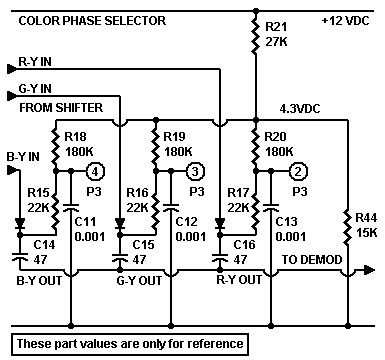
Phase selection process. Imagine the color wheel turning. The bottom, outer edge of a color segment moves about 1 inch past the center of the picture window. This segment’s contacts close, selecting one phase signal. This is the proper signal for the segment’s color. The output AC voltage appears at the anode of the conducting color phase selector diode. The circuit applies this output phase to the emitter of chrominance demodulator Q5.
Color terms. Col-R-Tel G-Y and B-Y reference vectors don't exactly match NTSC G-Y and B-Y. By adjusting Hue Control VR1, the viewer determines the position of the Col-R-Tel R-Y reference vector. This adjustment means that the Col-R-Tel R-Y vector might not match the NTSC R-Y vector.
Go to Page: 1 2 3 4 5 6 7 Next