|
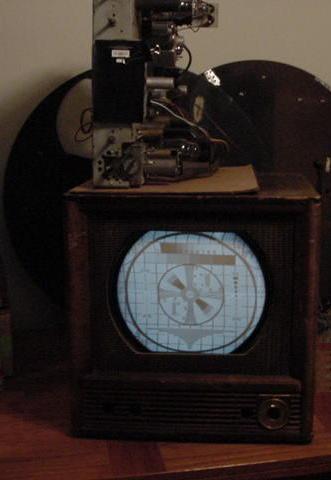
Cliff's Philco set produces its first picture after Cliff
installed a new flyback.
|
IF Bandpass. The ideal Col-R-Tel TV set should have as wide an IF
bandpass as possible. A wideband IF won't attenuate or degrade the color
signal coming into the set. Sets with four IF amplifier tube stages are the
best. A few models lend themselves extremely well. All these sets come from
major manufacturers.
Video amplifier. Another consideration is the quality and bandpass
of the set's video amplifier. The Col-R-Tel converter uses the TV's
video amplifier to amplify the color signal. The video amp must have as
wide a bandpass as possible. The video amp must also have high gain.
The best video amplifier would have two stages.
Sets with intercarrier sound. Most sets of this era are
intercarrier sets. Intercarrier sound circuits rely on both the video IF and
video amplifier stages. These stages increase the 4.5 MHz sound carrier
enough to drive audio detector circuitry. Intercarrier sets have a 4.5 MHz
sound trap in the video signal path. The trap prevents the sound carrier from
causing a herringbone moire pattern on the screen. Col-R-Tel also uses the
video amplifier for signal amplification. To use Col-R-Tel, you must bypass,
disconnect or at least detune the sound trap. Otherwise, it will severely
degrade the 3.58 MHz color signal. This signal is less than 1 MHz from the
sound IF frequency. One solution is to connect Col-R-Tel before the sound trap.
For instance, feed Col-R-Tel from the plate of the last video
amplifier tube. The idea is to get as much color signal to Col-R-Tel as
possible.
Suitable brands. For Col-R-Tel use, many collectors seek Philco
50T-1100 or 50T-1400 series sets. At least one of these models has a
10-inch CRT. Most models have 12-inch screens. All have a four-stage video IF
and a two-stage video amplifier. These sets make very crisp, detailed
black-and-white pictures. To drive the Col-R-Tel converter chassis, the Philco
sets have plenty of gain.
|
These manufacturers also made sets that work well with Col-R-Tel...
Studio monitors. Professional black-and-white video monitors work
very well with Col-R-Tel. These commercial TV monitors have no built-in
TV tuners. Yet these sets have a very wide video bandpass and most always,
aluminized CRTs. On such sets, reducing picture size to fit Col-R-Tel wheels
is very easy. Monitors from Conrac, RCA, Miratel, and Philips are ideal for
Col-R-Tel use.
Selecting a TV for Col-R-Tel use is simple. To recap, the ideal set
for Col-R-Tel use would be...
- A wood-cased, black-and-white, tube TV with a flat top (The flat top
supports the Col-R-Tel chassis and wheel unit.)
- An AC set with a power transformer
- A properly repaired and restored set that works
- A set with an aluminized, 12-inch, round picture tube, like the 12KP4
- A four-stage video IF amplifier
- A two-stage video amplifier
When used with Col-R-Tel, sets that meet these standards produce
beautiful, fine-textured color pictures. Col-R-Tel amazes those who have
never seen what color television looked like before color CRTs.
Go to Page:
1
2
3
Back
|
|